
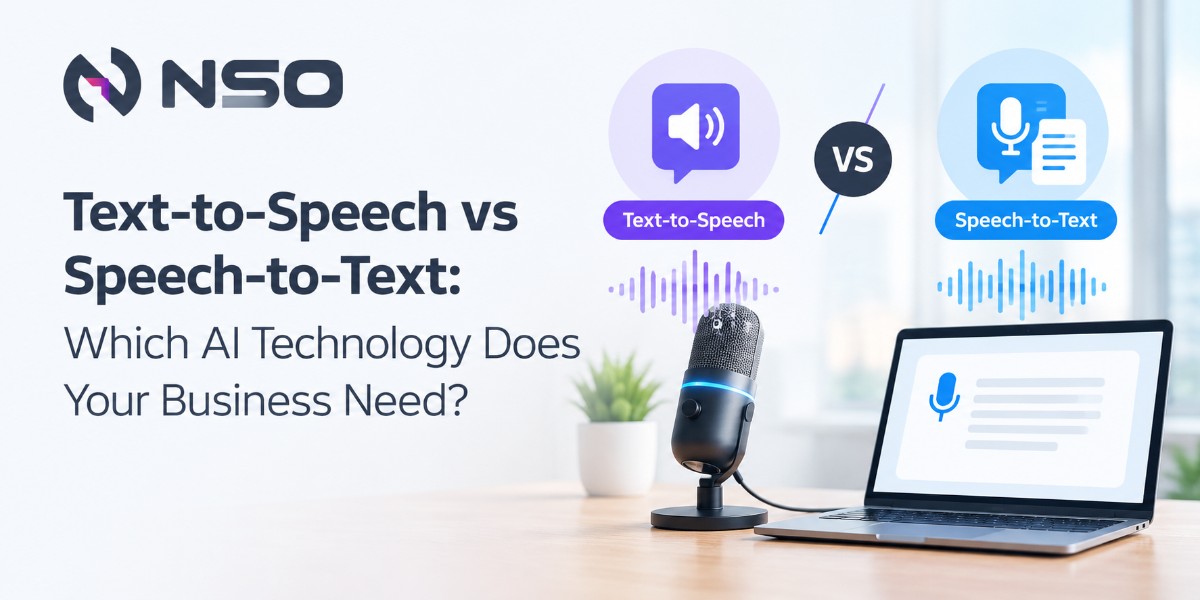

Text-to-Speech (TTS) converts written text into natural-sounding audio, making it useful for voice assistants, automated announcements, and accessibility. Speech-to-Text (STT) converts spoken words into written text, helping businesses automate transcription, analyze customer calls, and capture voice commands.
What if customers could interact with your business without typing or access information simply by listening? AI-powered voice technologies are transforming business communication, workflow automation, and digital accessibility. Two key technologies are Text-to-Speech (TTS), which converts written text into spoken audio, and Speech-to-Text (STT), which converts spoken language into written text.
Choosing between TTS and STT helps businesses improve automation and customer engagement. TTS enables voice assistants, while STT supports transcription and voice commands. Integrating both can create seamless voice interactions and scalable AI solutions.
How Does Speech-to-Text Work?
Speech-to-Text (STT), also known as automatic speech recognition (ASR), converts spoken words into written text using AI models trained on audio and language data.
The process generally involves the following steps:
- Audio input: A microphone, phone call, or recorded file captures the speaker's voice.
- Audio preprocessing: The system reduces noise and prepares the audio for analysis.
- Speech recognition: AI models analyze acoustic patterns and identify spoken words.
- Language processing: The system uses linguistic context to improve word selection, punctuation, and formatting.
- Text output: The recognized speech appears as text for further processing or storage.
For example, a customer support company can use STT to transcribe customer calls, identify recurring complaints, and maintain searchable conversation records. Businesses can also use speech-to-text API integration services to connect recognition capabilities with existing applications and workflows.
How Does Text-to-Speech Work?
Text-to-Speech (TTS) converts written content into synthesized speech. Modern AI-powered systems can generate natural-sounding voices with appropriate pronunciation, rhythm, and intonation.
Its typical workflow includes:
- Text input: The system receives text from an application, document, chatbot, or database.
- Text analysis: Language-processing components identify sentence structure, pronunciation, and linguistic patterns.
- Speech generation: An AI model generates audio based on the text and selected voice characteristics.
- Audio delivery: The generated speech is played through a website, mobile application, telephone system, or connected device.
For instance, an e-commerce business can use TTS to deliver spoken order updates, while an educational platform can convert learning materials into audio lessons. Businesses can customize voice, language, speaking speed, and pronunciation depending on the selected technology and application requirements.
The Differences Between TTS and Speech-to-Text
The primary difference is the direction in which information moves: STT converts speech into text, whereas TTS converts text into speech.
|
Feature |
Speech-to-Text (STT) |
Text-to-Speech (TTS) |
|
Main function |
Converts speech into text |
Converts text into audio |
|
Input |
Spoken audio |
Written text |
|
Output |
Text transcript |
Synthesized speech |
|
Primary technology |
Automatic speech recognition |
Speech synthesis |
|
Business objective |
Capture and analyze spoken information |
Deliver information through voice |
|
Common applications |
Call transcription, voice commands, meeting notes |
Voice assistants, audio content, automated announcements |
Which should your business choose? If your goal is to capture customer conversations, automate documentation, or analyze voice interactions, STT is a suitable starting point. If you want applications to speak responses, provide audio content, or support hands-free experiences, TTS may be more appropriate.
Businesses building voice-enabled AI assistants can integrate both technologies into a single solution.
Use Cases of Speech-to-Text and Text-to-Speech
Both technologies support different business functions across industries.
Speech-to-Text Use Cases
- Customer service: Transcribe calls and analyze customer feedback.
- Healthcare: Convert eligible clinical dictation into text for documentation, with appropriate privacy controls and human review.
- Meetings: Generate searchable transcripts and support meeting summaries.
- Education: Create transcripts of lectures and improve access to spoken content.
- Sales: Capture sales conversations and document customer requirements.
Text-to-Speech Use Cases
- Customer support: Power voice-based responses in automated calling systems.
- Banking and fintech: Deliver spoken account notifications and service updates.
- E-commerce: Read product information and order updates aloud.
- Education: Turn written lessons into audio learning resources.
- Accessibility: Help users with visual impairments or reading difficulties access digital information.
For example, a multilingual customer service platform can combine STT to understand a customer's spoken question with TTS to deliver an audible response. Additional language-processing components may be needed for translation or multilingual conversation handling.
Advantages and Disadvantages of Speech-to-Text and Text-to-Speech
Understanding the strengths and limitations of each technology helps businesses plan more effective implementations.
Text-to-Speech (TTS)
|
Advantages |
Disadvantages |
|
Increases accessibility for individuals with visual impairments or reading difficulties. |
Some voices may sound robotic or unnatural, especially in less advanced systems. |
|
Enhances learning and comprehension by reading text aloud. |
Difficulty pronouncing proper names, technical terms, or unusual words. |
|
Cost-effective compared to hiring professional voice actors. |
May lack emotional expression in certain contexts. |
|
Can generate realistic, human-like voices with modern AI. |
May have inaccuracies in certain languages or dialects. |
|
Enables faster and more scalable audio production. |
May struggle with brand names, foreign words, or specialized terminology. |
Speech-to-Text (STT)
|
Advantages |
Disadvantages |
|
Reduces manual transcription and documentation efforts. |
Background noise can reduce transcription accuracy. |
|
Makes audio conversations searchable and easier to analyze. |
Accents and regional languages may affect recognition quality. |
|
Supports voice commands and hands-free workflows. |
Overlapping speakers can make conversations difficult to transcribe. |
|
Helps businesses analyze customer interactions and feedback. |
Technical terms and unusual words may be recognized incorrectly. |
|
Speeds up meeting notes, call transcription, and record-keeping. |
Audio recordings and transcripts require appropriate data security. |
Both technologies require testing, monitoring, and privacy safeguards to perform reliably in business environments.
Speech-Language Models: The Future of STT and Text-to-Speech
Advances in speech and language models are making voice interfaces more natural, responsive, and context-aware. Traditional systems often process speech recognition and speech synthesis as separate tasks. Newer AI architectures increasingly support integrated speech understanding, conversational context, multilingual interactions, and lower-latency responses.
Emerging developments include:
- Multilingual speech processing: Better support for different languages, accents, and code-switching.
- Real-time voice assistants: Faster interactions between users and AI-powered applications.
- Emotion and prosody modeling: More expressive speech generation were supported by the model.
- Domain-specific recognition: Improved handling of industry terminology and specialized vocabulary.
- Integrated voice AI: Systems that combine speech recognition, language models, business data, and speech generation.
However, performance still depends on audio quality, model capabilities, language coverage, infrastructure, and the complexity of the task. Businesses should evaluate accuracy, latency, data handling, scalability, and integration requirements before selecting a solution.
Conclusion
Text-to-Speech and Speech-to-Text solve different communication challenges, but both can play an important role in modern business automation. STT helps organizations capture and analyze spoken information, while TTS makes digital content accessible through natural-sounding audio. For businesses developing voice-enabled applications, AI assistants, customer support systems, or multilingual communication platforms, combining both technologies can create more seamless customer experiences.
Nova Strategic Operations helps businesses explore customized AI development, speech technology integration, conversational AI, and workflow automation based on their operational requirements. Whether you need speech-to-text capabilities, AI-generated voice responses, or an integrated voice-enabled application, the right solution begins with a clear understanding of your users, systems, and business objectives.
Looking to integrate AI voice technology into your business? Contact us to discuss a tailored solution for your requirements.
Frequently Asked Questions
1. What is the main difference between Text-to-Speech and Speech-to-Text?
Text-to-Speech converts written text into audio, while Speech-to-Text converts spoken words into written text.
2. Can a business use TTS and STT together?
Yes, businesses can combine both technologies to build voice-enabled chatbots, virtual assistants, and automated customer support systems.
3. Which technology is better for customer support automation?
Both are useful: STT transcribes customer conversations, while TTS generates automated voice responses.
4. Do Text-to-Speech and Speech-to-Text support multiple languages?
Yes, many modern TTS and STT solutions support multiple languages, including regional languages, depending on the provider and model.
5. How can businesses integrate TTS and STT into existing software?
Businesses can integrate TTS and STT through APIs, SDKs, cloud services, or custom AI solutions connected to existing applications and business systems