

Imagine a customer browsing your online store at midnight, looking for the perfect product but unsure which option to choose. Instead of leaving the website to search elsewhere, they ask a simple question and receive an instant, personalized response that helps them make a purchase.
This is how conversational AI in e-commerce transforms online shopping by connecting customer queries with relevant products, real-time assistance, and seamless buying experiences. By combining natural language processing (NLP), machine learning, and AI-powered automation, businesses can engage shoppers throughout their buying journey.
For e-commerce companies, conversational AI is more than a customer support tool; it is a practical solution for improving engagement, simplifying product discovery, and turning potential customers into paying buyers.
What Is Conversational AI in E-commerce?
Conversational AI enables online stores to interact with customers through chatbots, messaging platforms, and voice assistants using natural language. Unlike traditional rule-based chatbots that follow predefined scripts, advanced conversational AI solutions can interpret customer intent, understand context, and deliver more relevant responses.
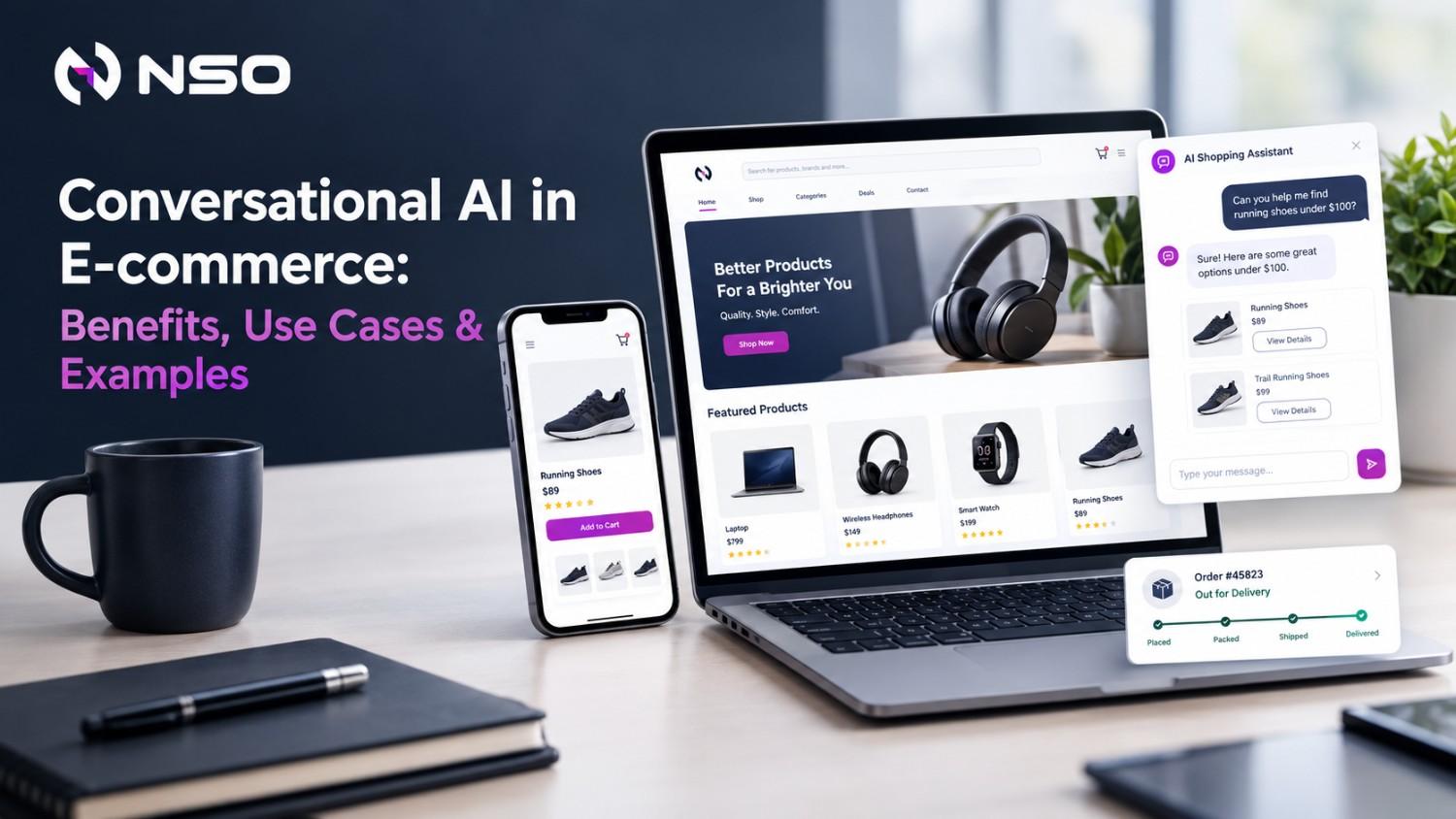
For example, a customer searching for running shoes might ask, "Which shoes are suitable for daily jogging under ₹3,000?" The AI assistant can understand the budget and intended use, recommend suitable products, and help the shopper compare available options.
This makes online shopping more interactive while reducing the effort customers need to find the right product.
How Conversational AI Works in E-commerce: Step-by-Step
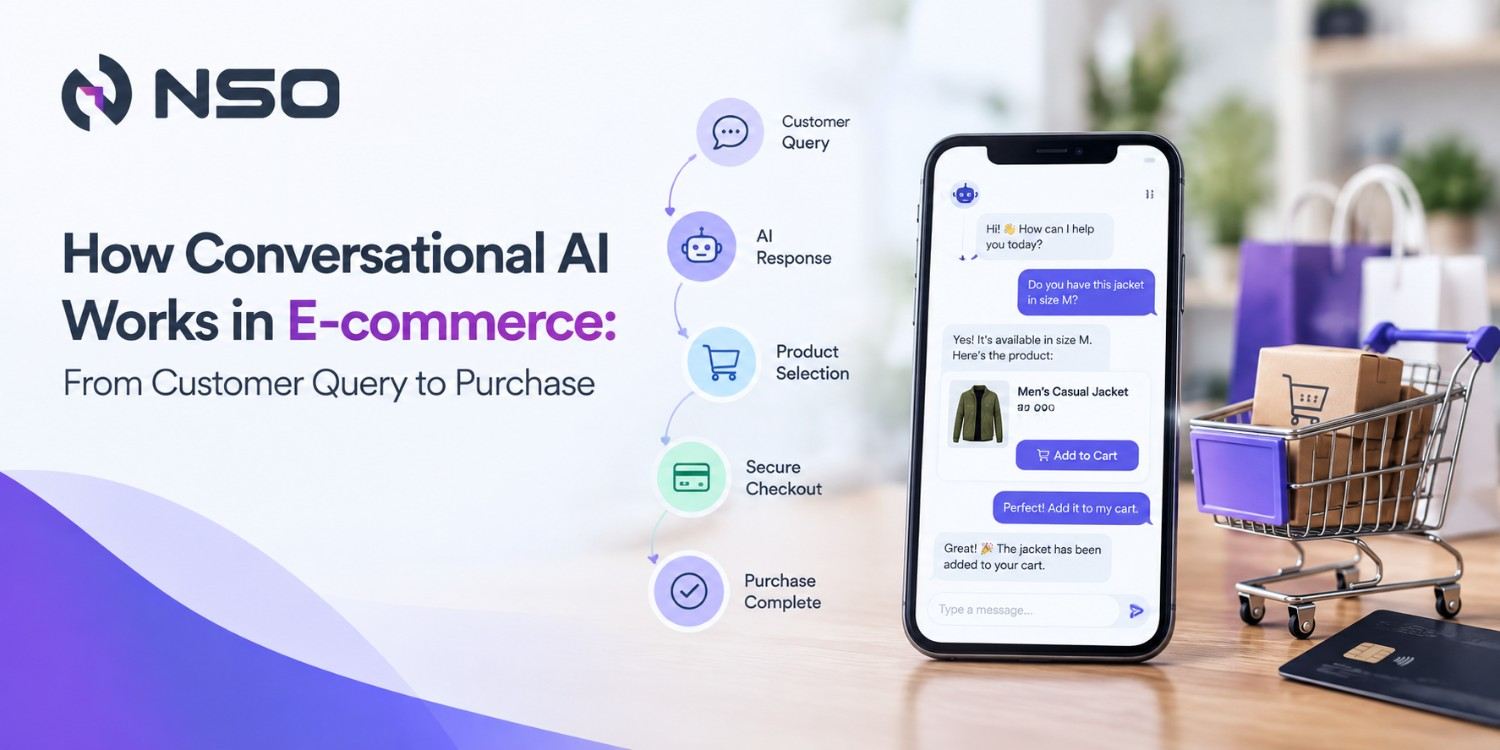
Conversational AI connects several technologies and business systems to guide shoppers from their initial questions to checkout.
1. Understanding Customer Queries
The process begins when a customer enters a message or speaks to an AI assistant. Natural language processing helps the system interpret the query, identify important details, and understand the customer's intent.
Example: A customer asks, "Do you have waterproof backpacks for college?"
The AI identifies the product category, waterproof feature, and intended use to understand what the customer needs.
2. Finding Relevant Product Information
After understanding the query, the AI retrieves relevant information from connected product catalogs, inventory systems, pricing databases, and knowledge bases.
It can check product specifications, current availability, delivery options, and other relevant details before responding.
Example: The assistant recommends three waterproof backpacks that are currently available and match the customer's requirements.
3. Providing Personalized Recommendations
Conversational AI can use available browsing activity, stated preferences, purchase history, and product attributes to personalize recommendations, subject to appropriate data permissions.
Instead of displaying generic suggestions, it can narrow down options based on a shopper's needs.
For instance, a customer purchasing a smartphone may receive recommendations for compatible cases, chargers, or screen protectors.
4. Answering Questions and Addressing Concerns
Customers often hesitate before purchasing because they have questions about product quality, payment methods, return policies, or delivery timelines.
Conversational AI provides quick answers using approved business information and connected systems. If a query requires human judgment or the system cannot provide a reliable answer, it can transfer the conversation to a support representative.
This helps customers make informed purchasing decisions without unnecessary delays.
5. Supporting Checkout and Purchase Completion
Once a customer selects a product, conversational AI can guide them through the next steps, explain available payment methods, and provide access to the appropriate checkout process.
For example, if a customer asks, "How can I complete my order?", the assistant can direct them to checkout and explain the steps involved.
When integrated with order management systems, it can also help customers retrieve order confirmations and delivery updates after purchasing.
Key Benefits of Conversational AI for E-commerce Businesses
E-commerce businesses can use conversational AI to improve several stages of the customer journey.
- 24/7 customer support: Answer common questions outside regular business hours.
- Faster product discovery: Help shoppers find relevant products through natural-language queries.
- Personalized shopping experiences: Recommend products based on customer preferences and shopping context.
- Improved conversion opportunities: Address purchase-related concerns before customers abandon their carts.
- Reduced support workload: Automate repetitive enquiries so human agents can focus on complex cases.
- Consistent customer communication: Provide standardized answers across supported digital channels.
The impact depends on integration quality, response accuracy, customer experience, and how effectively the solution supports actual shopping needs.
Real-World Example: From Customer Query to Purchase
Consider an online fashion retailer implementing conversational AI on its website.
A shopper asks, "I need a formal shirt for an office meeting under ₹1,500."
The AI assistant understands the budget and occasion, retrieves matching shirts from the product catalog, and displays available sizes and colors. The shopper asks about delivery time, and the assistant checks the relevant shipping information. After comparing two options, the customer selects a shirt and proceeds to checkout.
Following the purchase, the assistant can provide order status information when connected to the retailer's order management system.
This example illustrates how conversational AI can support the entire shopping journey rather than simply answering isolated questions.
How Can E-commerce Businesses Implement Conversational AI?
Businesses should start with clear objectives and a focused implementation strategy.
Identify customer pain points: Review frequently asked questions, product searches, cart abandonment, and support requests.
Choose the right AI solution: Select chatbot or conversational AI capabilities that match your business requirements.
Integrate business systems: Connect product catalogs, inventory, CRM, payment workflows, and order management where needed.
Train and test the assistant: Validate responses using realistic customer queries, including ambiguous and complex questions.
Monitor Performance: Track resolution rates, product click-throughs, conversion rates, customer satisfaction, and escalation frequency.
A phased rollout allows businesses to identify gaps and improve performance before expanding conversational AI across additional customer touchpoints.
Conclusion
Conversational AI is transforming e-commerce by making online shopping more personalized, responsive, and convenient. From understanding customer queries and recommending relevant products to resolving purchase concerns and supporting checkout, it helps businesses create a smoother customer journey.
Nova Strategic Operations helps businesses develop customized AI solutions aligned with their customer engagement goals and operational requirements. Whether you need an AI-powered shopping assistant, personalized product recommendations, or intelligent customer support automation, the right solution can help your business improve digital experiences and build stronger customer relationships.
Ready to make your online store smarter? Contact us to explore conversational AI development for e-commerce and turn customer conversations into meaningful business opportunities.
Frequently Asked Questions
1. How does conversational AI work in e-commerce?
Conversational AI uses natural language processing, machine learning, and connected business systems to understand customer questions, retrieve relevant information, recommend products, and guide shoppers through purchasing.
2. How does conversational AI help increase e-commerce sales?
It can help customers discover products faster, receive personalized recommendations, resolve purchasing concerns, and navigate checkout. These capabilities may improve conversion rates when implemented effectively.
3. What is the difference between an e-commerce chatbot and conversational AI?
A traditional chatbot often follows predefined rules and decision trees. Conversational AI can interpret natural language, recognize customer intent, maintain conversational context, and provide more flexible responses.
4. Can conversational AI recommend products to online shoppers?
Yes. When connected to product catalogs and permitted customer data, conversational AI can recommend products based on preferences, budget, product features, browsing context, and previous purchases.
5. Can conversational AI integrate with an existing e-commerce website?
Yes. Conversational AI can often integrate with existing e-commerce platforms through APIs and compatible connectors. The implementation depends on the platform, available system interfaces, security requirements, and the business workflows involved.