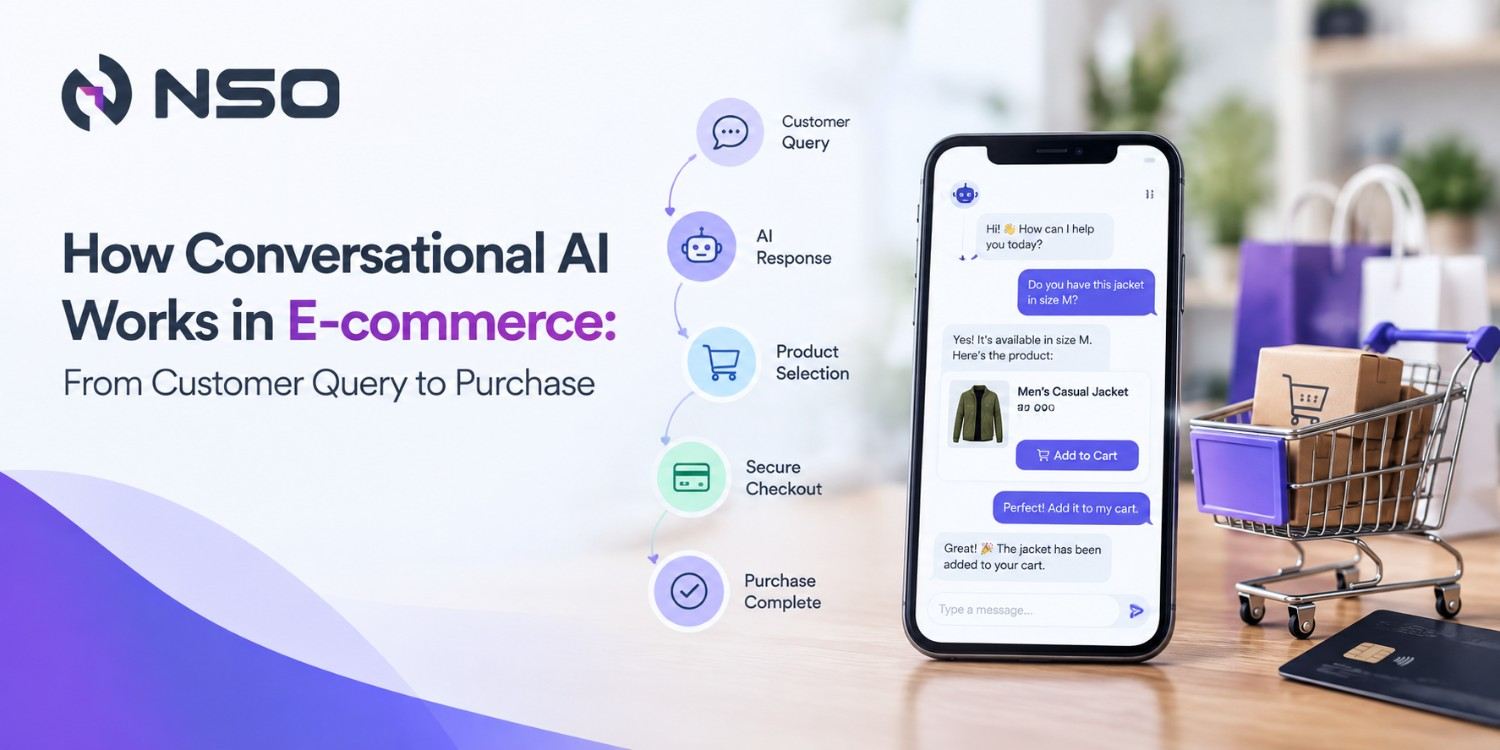


What if every online shopper could get instant answers, personalized product recommendations, and shopping assistance without waiting for a customer support representative? Conversational AI is making this possible by transforming how e-commerce businesses interact with customers.
From answering product-related questions to tracking orders and recovering abandoned carts, AI-powered conversations help online stores deliver faster, more personalized shopping experiences.
Today, customers expect more than a basic online shopping experience. They want quick responses, relevant suggestions, and seamless support throughout their buying journey. Conversational AI in e-commerce helps businesses meet these expectations through intelligent chatbots, virtual shopping assistants, and automated customer service systems.
For growing e-commerce brands, implementing the right conversational AI solution can improve customer engagement, simplify operations, and create more opportunities to convert visitors into buyers.
What Is Conversational AI in E-commerce?
Conversational AI in e-commerce refers to the use of artificial intelligence technologies, such as natural language processing (NLP), machine learning, and generative AI, to communicate with customers through text or voice.
Unlike traditional rule-based chatbots that respond only to predefined questions, advanced conversational AI systems can understand customer intent, interpret product queries, maintain conversational context, and provide relevant responses.
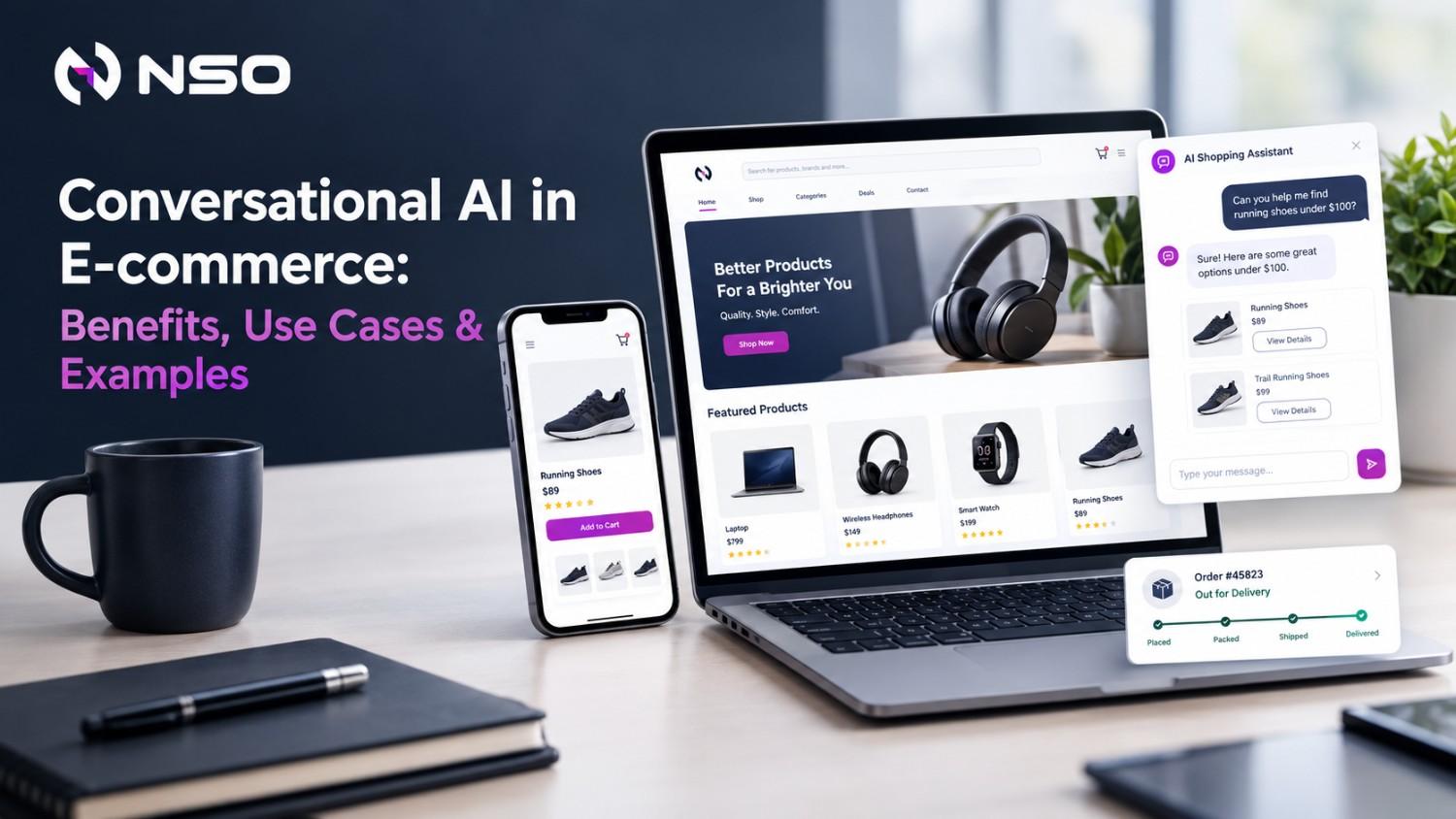
For example, a customer might ask, "I need running shoes under ₹3,000 for daily workouts." An AI chatbot for e-commerce can understand the budget, product category, and intended use before suggesting suitable products.
These systems can also integrate with product catalogs, inventory management platforms, customer relationship management (CRM) systems, and order management software to deliver more useful, context-aware assistance.
Key Benefits of Conversational AI for E-commerce
Conversational AI helps e-commerce businesses improve customer support, personalize shopping experiences, boost conversions, and streamline operations efficiently.
1. 24/7 AI-Powered Customer Support
Customers often shop outside regular business hours and expect immediate assistance. Conversational AI can answer frequently asked questions about delivery, payment methods, returns, refunds, and product availability around the clock.
Example: A customer checking an order at midnight can ask, "Where is my package?" The chatbot can retrieve the latest tracking information from the connected order management system and provide an update without human intervention.
This approach reduces repetitive support requests and allows customer service teams to focus on complex issues.
2. Personalized Product Recommendations
Generic product suggestions may not meet individual customer needs. Conversational AI can use customer preferences, shopping history, product attributes, and current queries to recommend relevant items.
Example: A customer looking for skincare products for dry skin can receive recommendations based on their stated preferences, product ingredients, and budget.
Personalized assistance makes product discovery easier and helps shoppers make informed purchasing decisions.
3. Improved Sales and Conversions
An AI sales assistant for e-commerce can guide customers from product discovery to checkout. It can answer questions about sizes, features, compatibility, pricing, and product comparisons.
For instance, a shopper comparing two laptops can ask the assistant which model is better for video editing within a specific budget. The AI can explain the relevant differences and direct the shopper to suitable product pages.
By addressing purchase-related doubts promptly, businesses can reduce friction in the buying journey and create more opportunities for conversions.
4. Reduced Cart Abandonment
Customers may abandon their carts because of unexpected shipping costs, payment concerns, or unanswered product questions. Conversational AI can help address these concerns before shoppers leave.
For example, an AI assistant can explain delivery timelines, clarify return policies, or help a customer find an alternative product that fits their budget.
When supported by appropriate consent and communication preferences, businesses can also use conversational messaging to remind shoppers about abandoned carts.
5. Multilingual Customer Engagement
E-commerce businesses serving customers across India often need to communicate in multiple languages. Conversational AI can support interactions in languages such as English, Hindi, and Marathi, depending on the solution's capabilities.
This makes shopping assistance more accessible to regional audiences and helps businesses serve customers with different language preferences.
Real-World Examples of Conversational AI in E-commerce
E-commerce conversational AI solutions can support different stages of the customer journey. Here are some practical examples:
- Fashion and apparel: An AI chatbot helps shoppers find clothing by size, color, occasion, and budget.
- Electronics: A virtual assistant compares product specifications and recommends devices based on customer requirements.
- Beauty and skincare: A conversational assistant suggests suitable products based on skin concerns and stated preferences.
- Grocery delivery: Customers can check product availability, discover alternatives, and receive order updates.
- Home and furniture: An AI assistant helps shoppers explore furniture based on room dimensions, style, material, and price range.
- Customer service: A chatbot answers questions about returns, refunds, delivery schedules, and order status.
These examples demonstrate how conversational AI can be adapted to different product categories, customer expectations, and business workflows.
Use Cases of Conversational AI in E-commerce
Conversational AI supports customers at different stages of the online shopping journey, from discovering products to resolving post-purchase issues. Here are some important use cases for e-commerce businesses.
1. AI-Powered Product Discovery
An AI shopping assistant helps customers find products based on their preferences, budget, size, color, and specific requirements. This makes product discovery faster and more convenient.
2. Order Tracking and Delivery Updates
Customers can ask about order status, estimated delivery dates, and shipping updates through an AI chatbot. Integration with order management systems enables the assistant to provide relevant information.
3. Automated Customer Support
Conversational AI handles routine questions about returns, refunds, payment methods, warranties, and delivery policies. Complex or sensitive issues can be transferred to human support agents.
4. Cart Abandonment Assistance
AI assistants can help customers overcome purchasing obstacles by answering product questions, explaining shipping policies, and guiding them through checkout. Businesses can also send permitted follow-up reminders through appropriate channels.
5. Personalized Upselling and Cross-Selling
An AI sales assistant for e-commerce can recommend complementary products or relevant upgrades based on a shopper's current selection and stated needs. For example, a customer purchasing a camera might receive suggestions for compatible lenses or a memory card.
6. Multilingual Shopping Assistance
Businesses can use conversational AI to communicate with customers in their preferred supported languages. This is particularly useful for Indian e-commerce brands serving customers across different regions.
How to Implement Conversational AI in E-commerce
Successful implementation requires more than adding a chatbot to a website. Businesses should follow a structured approach.
Identify customer needs: Determine the most common questions, support bottlenecks, and shopping challenges.
Choose suitable AI capabilities: Decide whether the business needs a rule-based chatbot, generative AI assistant, voice interface, or a combination.
Integrate business systems: Connect the solution with product catalogs, inventory, CRM, payment information where appropriate, and order tracking systems.
Personalize customer interactions: Configure recommendations and responses around customer intent, product details, and available data.
Prioritize security: Apply access controls, data protection measures, and appropriate consent practices.
Measure performance: Monitor response accuracy, customer satisfaction, resolution rates, conversion rates, and cart abandonment.
Start with a focused use case, such as order tracking or product discovery, and expand as the solution demonstrates value.
Best Practices for Conversational AI in E-commerce
Implementing conversational AI successfully requires careful planning, accurate information, and continuous optimization. Businesses should follow these best practices to create reliable and helpful customer experiences.
1. Start with Clear Business Objectives
Identify the main problem the AI assistant should solve, such as reducing repetitive support requests, improving product discovery, or assisting with order tracking. Begin with a focused use case before expanding its capabilities.
2. Train AI with Accurate Business Information
Use updated product catalogs, pricing details, inventory information, shipping policies, and return guidelines. Regular updates help prevent outdated or misleading responses.
3. Integrate AI with Existing Systems
Connect the assistant with relevant e-commerce platforms, CRM software, inventory systems, and order management tools. Reliable integrations enable personalized assistance and accurate, real-time information where supported.
4. Keep Conversations Simple and Natural
Design clear, concise responses that help customers complete tasks without unnecessary steps. Provide useful suggestions and allow shoppers to ask follow-up questions naturally.
5. Provide Human Support When Needed
AI should recognize when a request requires human judgment, emotional sensitivity, or additional investigation. Offer a straightforward escalation process so customers can reach a support representative when necessary.
6. Prioritize Customer Privacy and Security
Protect personal and payment-related information through appropriate access controls, encryption, data minimization, and secure integrations. Follow applicable privacy requirements and obtain consent where necessary.
7. Monitor Performance and Improve Continuously
Track metrics such as response accuracy, customer satisfaction, resolution rates, conversion rates, and escalation frequency. Use customer feedback and conversation analysis to identify gaps and improve the assistant over time.
Following these practices helps businesses build e-commerce conversational AI solutions that are useful, secure, and aligned with customer expectations.
Why Businesses Need E-commerce Conversational AI Solutions
As online competition increases, customer experience becomes an important differentiator. E-commerce conversational AI solutions help businesses manage repetitive enquiries, offer personalized assistance, and provide consistent support across digital channels.
However, results depend on accurate product information, reliable system integrations, appropriate escalation to human agents, and continuous performance monitoring. AI should complement customer service teams rather than replace human support in situations requiring judgment or empathy.
Businesses that implement conversational AI strategically can create smoother shopping journeys while improving operational efficiency and customer engagement.
Conclusion
Conversational AI is changing how e-commerce businesses support customers, recommend products, and manage online shopping experiences. From 24/7 assistance and multilingual communication to personalized recommendations and cart recovery, it offers practical opportunities to improve customer interactions throughout the buying journey.
Nova Strategic Operations helps businesses develop and integrate customized AI solutions aligned with their customer journeys, operational requirements, and growth objectives. Whether you need an AI chatbot for e-commerce, an intelligent shopping assistant, or AI-powered customer support for e-commerce, the right solution can help your business serve customers more efficiently and scale confidently.
Ready to transform your online shopping experience? Contact Us to explore conversational AI solutions tailored to your e-commerce business.
Frequently Asked Questions
1. What is conversational AI in e-commerce?
Conversational AI in e-commerce uses technologies such as natural language processing, machine learning, and generative AI to communicate with shoppers, answer questions, recommend products, and assist with orders through chat or voice interfaces.
2. How does an AI chatbot for e-commerce improve customer experience?
An AI chatbot provides instant responses, helps customers discover relevant products, answers common questions, and supports order tracking. It can also offer multilingual assistance and escalate complex issues to human agents.
3. Can conversational AI increase e-commerce sales?
Yes. Conversational AI can help shoppers find suitable products, compare options, resolve purchase-related doubts, and navigate checkout. These capabilities can create more opportunities for conversions, although actual results depend on implementation and customer needs.
4. What are some examples of conversational AI in e-commerce?
Common examples include virtual shopping assistants, automated order-tracking chatbots, personalized product recommendation tools, multilingual support assistants, and AI-powered systems that help customers resolve delivery or return enquiries.
5. How much does it cost to implement conversational AI for an e-commerce business?
The cost depends on the solution's complexity, AI capabilities, number of supported languages, integrations, expected conversation volume, and security requirements. A basic FAQ chatbot generally requires less investment than a customized AI assistant integrated with inventory, CRM, and order management systems