
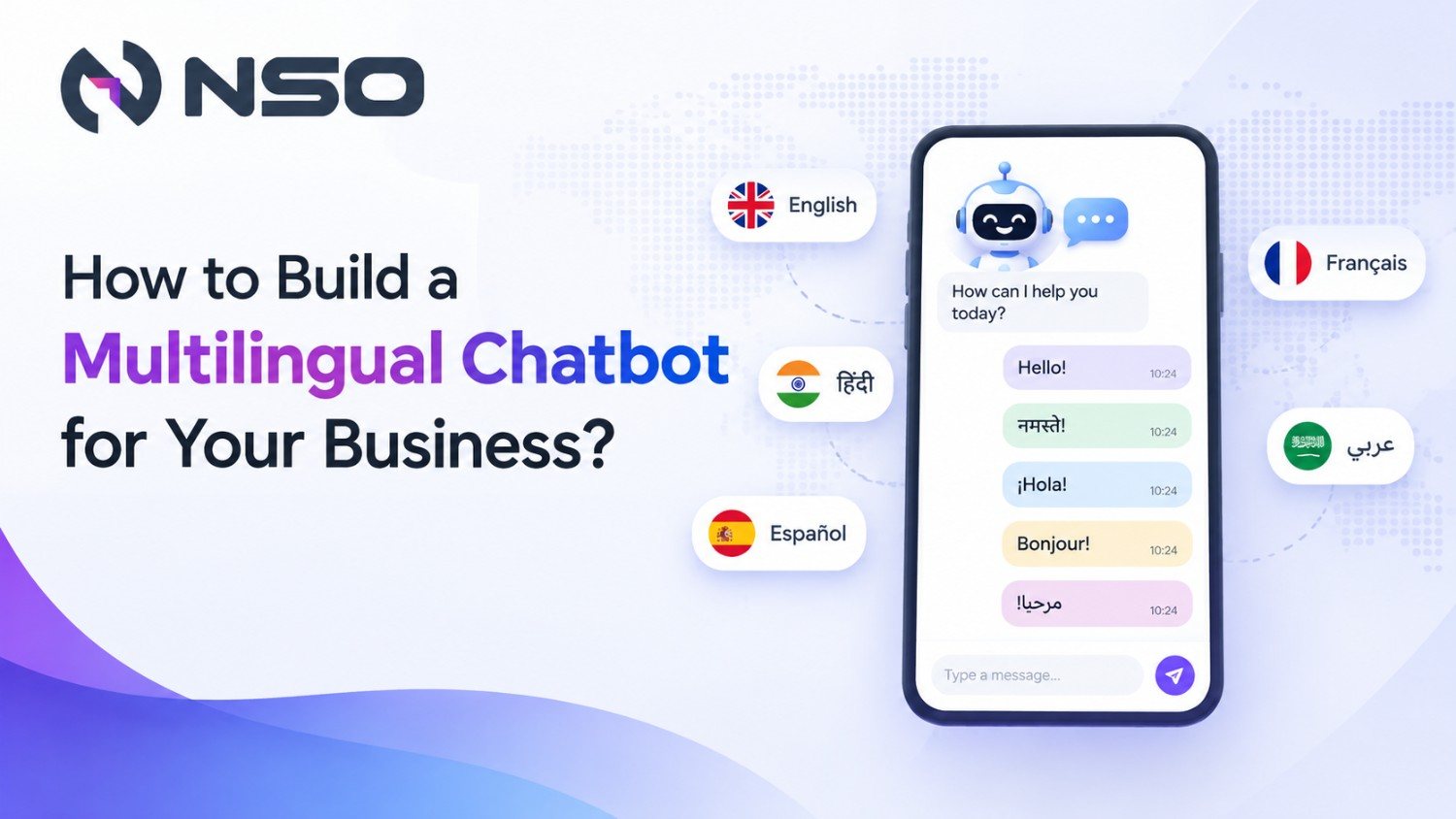

Your customers speak different languages, so why should your chatbot speak only one? In a digitally connected market, language can become a hidden barrier between businesses and potential customers.
A multilingual chatbot helps companies communicate with customers in their preferred languages, provide faster support, qualify leads, and create more accessible digital experiences. From English and Hindi to Marathi, Tamil, Bengali, or international languages, businesses can use AI-powered chatbots to serve diverse audiences without building separate support systems for every language.
Multilingual chatbot can automate enquiries, assist sales teams, answer product questions, collect customer information, schedule meetings, and route complex requests to the right employee. Building one successfully requires the right combination of AI, natural language processing, multilingual data, integrations, security, and continuous optimization.
How Does a Multilingual Chatbot Work?
A multilingual chatbot uses Natural Language Processing (NLP), machine learning, and language-processing technologies to understand user messages and generate relevant responses in different languages.
The typical workflow looks like this:
- The user sends a message: The customer asks a question in their preferred language.
- Language detection: The chatbot identifies the language automatically or uses the user's selected language.
- Intent understanding: NLP analyzes the message to understand what the customer actually wants.
- Knowledge retrieval: The chatbot finds relevant information from its knowledge base, business systems, or connected APIs.
- Response generation: AI creates an appropriate response based on the user's language and context.
- Human escalation: If the chatbot cannot confidently resolve an issue, it can transfer the conversation to a human agent.
For example, a real estate company operating across Maharashtra can allow customers to ask about properties in English, Hindi, or Marathi. The chatbot can answer property-related questions, collect requirements such as budget and location, and pass qualified leads to the sales team.
How to Build a Multilingual Chatbot?
Building a multilingual chatbot involves more than translating existing chatbot responses. The system should understand language, context, intent, cultural variations, and business requirements.
1. Define Business Objectives
Start by identifying what the chatbot needs to achieve. Common objectives include:
- Customer support automation
- Lead generation and qualification
- Product or service recommendations
- Appointment scheduling
- Order or application status
- FAQs and self-service support
- Internal employee assistance
Clear objectives help determine the chatbot's features, integrations, and AI architecture.
2. Select Target Languages
Identify the languages your customers actually use instead of adding languages simply for coverage. Consider website analytics, customer demographics, support requests, and target markets.
A Mumbai-based business, for example, may prioritize English, Hindi, and Marathi before expanding to additional Indian or international languages.
3. Choose the Right AI and NLP Technology
The chatbot needs technology capable of handling multiple languages accurately. Depending on the use case, businesses can combine multilingual NLP models, large language models, translation APIs, speech technologies, and custom AI components.
The goal should be meaning-based understanding rather than word-for-word translation.
4. Build a Multilingual Knowledge Base
Prepare business information for every supported language. This may include:
- Product and service information
- FAQs
- Pricing information
- Policies
- Troubleshooting instructions
- Industry-specific terminology
A well-structured knowledge base helps the chatbot provide consistent and accurate answers.
5. Integrate Business Systems
For B2B applications, integrations can significantly increase the chatbot's value. Connect it with systems such as:
- CRM platforms
- ERP software
- Helpdesk systems
- Payment gateways
- Appointment platforms
- E-commerce platforms
- Internal databases
For example, a multilingual chatbot connected to a CRM can automatically capture a customer's name, requirements, language preference, and enquiry details for sales follow-up.
6. Test Language Accuracy and Context
Testing should cover more than grammar. Evaluate whether the chatbot understands:
- Regional expressions
- Spelling variations
- Mixed-language conversations
- Industry terminology
- Different sentence structures
- Context across multiple messages
For Indian businesses, testing code-mixed conversations, such as Hinglish or Marathi-English, can be particularly valuable.
7. Add Analytics and Continuous Improvement
Monitor conversations to identify unanswered questions, incorrect responses, language-specific issues, and conversion opportunities. Use these insights to improve the knowledge base, prompts, workflows, and chatbot responses continuously.
Why Do Businesses Need Multilingual Chatbots?
A multilingual chatbot can create measurable business value when implemented around genuine customer and operational needs.
Key benefits include:
Wider customer reach: Communicate with customers across different linguistic markets without requiring a separate support team for every language.
24/7 customer engagement: AI chatbots can respond to enquiries outside conventional business hours.
Better lead generation: Chatbots can engage website visitors, ask qualification questions, collect contact details, and send high-value leads to sales teams.
Lower support workload: Automating repetitive multilingual questions allows human agents to focus on complex customer issues.
Improved customer experience: Customers can interact in a language they understand comfortably, reducing communication friction.
Scalable expansion: Businesses entering new regions can introduce additional languages without completely redesigning their customer-support infrastructure.
Conclusion
A multilingual chatbot can turn language diversity from a business challenge into a growth opportunity. By combining multilingual NLP, AI, a reliable knowledge base, business-system integrations, human escalation, and continuous testing, companies can create chatbot experiences that support customers and generate business value across markets.
For businesses planning a multilingual AI chatbot, the right implementation strategy should begin with business objectives, target audiences, languages, workflows, integrations, and security requirements, not simply translation.
NSO helps businesses build and integrate customized AI chatbot solutions tailored to their customer journeys, business processes, and growth goals. From multilingual customer support and lead qualification to AI-powered sales assistance and enterprise workflow automation, our solutions help you communicate smarter and scale faster. Contact us to turn customer conversations into business growth? Partner with NSO to build your custom AI chatbot today.
Frequently Asked Questions
1. What is a multilingual chatbot?
A multilingual chatbot is an AI-powered conversational system that can understand and respond to users in multiple languages. It uses technologies such as NLP, machine learning, large language models, and translation capabilities to communicate with customers based on their preferred language.
2. How much does it cost to build a multilingual chatbot?
The cost depends on factors such as the number of languages, AI model, chatbot complexity, integrations, customization, security requirements, and deployment environment. A simple FAQ chatbot generally requires less development than an enterprise chatbot connected to CRM, ERP, or other business systems.
3. Can a multilingual chatbot understand Hindi, Marathi, or other Indian languages?
Yes. Modern AI and NLP technologies can support several Indian languages. However, businesses should test language accuracy, regional terminology, spelling variations, and code-mixed conversations to ensure the chatbot provides reliable responses.
4. Can a multilingual chatbot generate and qualify leads?
Yes. A chatbot can ask visitors qualification questions, collect contact details, understand requirements, recommend relevant products or services, and send qualified leads to a CRM or sales team for follow-up.
5. Can a multilingual chatbot connect with existing business software?
Yes. Multilingual chatbots can be integrated with CRM, ERP, helpdesk, payment, scheduling, e-commerce, databases, and other business applications through APIs and middleware. These integrations allow the chatbot to provide personalized and real-time information instead of relying only on static FAQs