


What if your AI could move beyond answering questions and actually get the work done? That shift is changing how businesses think about automation, software, and decision-making. Generative AI, Agentic AI, and AI Agents are often used interchangeably, but they solve very different business problems.
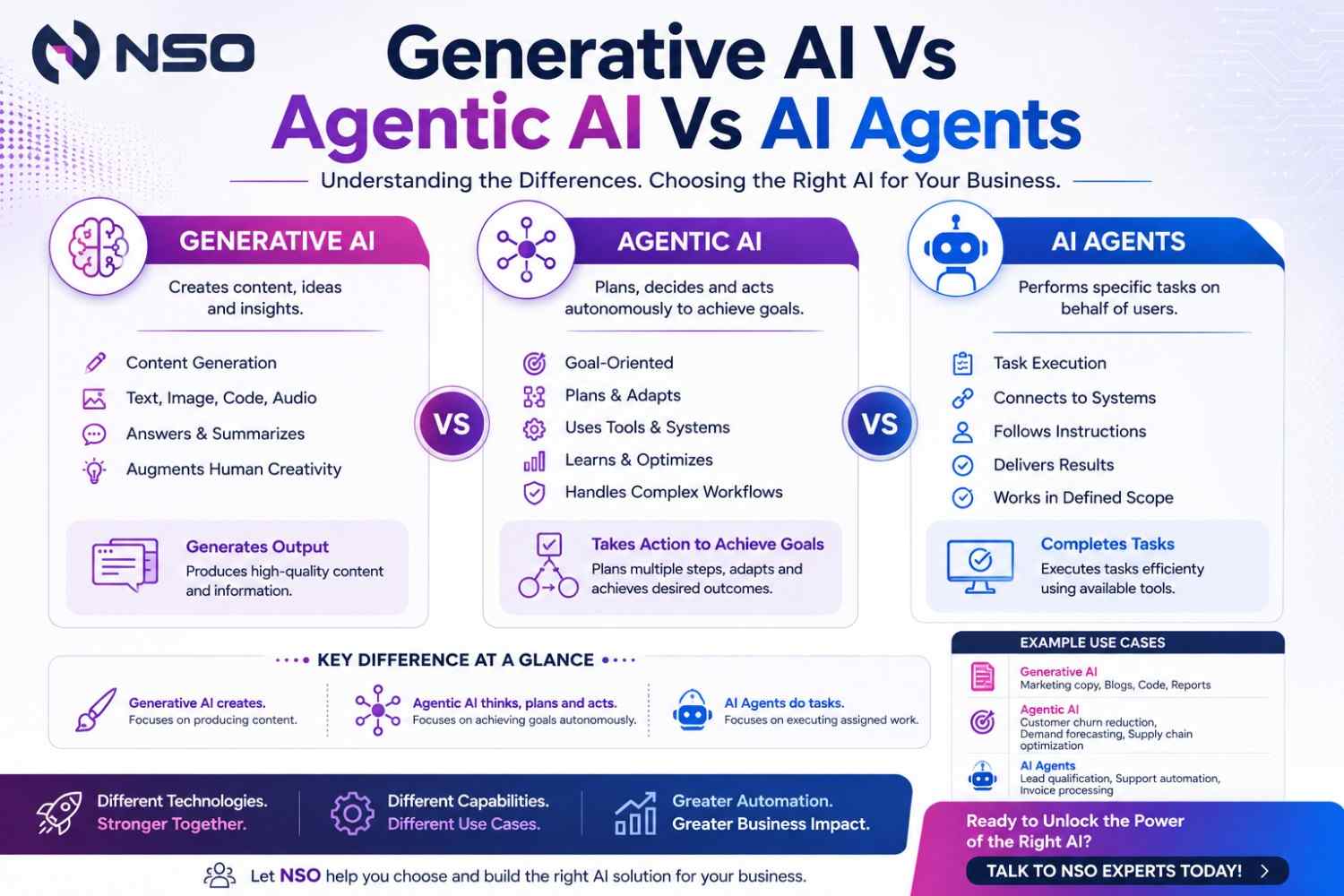
Generative AI focuses on creating content and insights, AI Agents execute specific tasks, while Agentic AI represents a broader approach to autonomous, goal-driven decision-making. Understanding these differences matters when investing in AI because choosing the wrong architecture can leave your organization with an expensive chatbot when what you really needed was an intelligent workflow.
In this blog to Generative AI Vs Agentic AI Vs AI Agents, we’ll break down how each technology works, where it fits, and when businesses should use one over another.
What Is Generative AI?
Generative AI is designed to create new content based on patterns learned from large datasets. It can generate text, images, code, audio, summaries, reports, product descriptions, and other forms of digital content.
Unlike traditional software that follows predefined rules, generative AI can interpret natural-language instructions and produce contextually relevant outputs.
Example
An e-commerce company can use generative AI to create product descriptions for thousands of products. Instead of manually writing every description, the marketing team provides product information and the AI generates optimized copy in seconds.
How Does Generative AI Work?
Generative AI typically works through foundation models such as large language models. The process generally involves:
- User input: A prompt, document, question, or instruction is provided.
- Context processing: The AI analyzes the input and relevant information.
- Pattern prediction: The model predicts the most appropriate sequence or output.
- Content generation: It produces a response based on learned patterns and available context.
- Human review: For business-critical applications, the output can be reviewed before being used.
The key point is that Generative AI primarily generates an output. It does not inherently mean the system can independently plan and execute a complete business process.
What Are AI Agents?
AI Agents are software systems designed to perform tasks on behalf of users or businesses. Instead of simply generating an answer, an agent can interact with applications, databases, APIs, and other digital systems to complete a defined objective.
Example
Imagine a sales AI Agent that receives a new lead. It can check the CRM, identify the lead source, research available customer information, send a personalized email, schedule a meeting, and update the CRM record.
The agent is not simply telling an employee what to do, it is taking action through connected systems.
How Do AI Agents Work?
A typical AI Agent combines several components:
- Input and perception: Understands requests, events, or business data.
- Reasoning: Determines what needs to happen.
- Tool usage: Connects with APIs, CRM systems, databases, calendars, or other software.
- Task execution: Performs the required action.
- Feedback: Checks results and responds to changes or failures.
For example, an AI Agent handling customer support could identify a customer's issue, retrieve account information, check an order status, initiate an eligible refund, and update the support ticket.
This makes AI Agents particularly valuable for task-level automation.
What Is Agentic AI?
Agentic AI is a broader concept focused on creating AI systems that can pursue goals, make decisions, plan multiple steps, adapt to changing conditions, and take action with limited human intervention.
The important distinction is scope. An AI Agent may complete a specific task, while an Agentic AI system can coordinate multiple actions and agents toward a larger business objective.
Example
Consider an enterprise that wants to reduce customer churn.
An Agentic AI system could analyze customer behavior, identify accounts showing churn signals, prioritize high-risk customers, determine appropriate engagement strategies, trigger personalized communications, assign cases to human teams when necessary, and monitor whether retention efforts are working.
The system is not simply responding to a command. It is working toward a business goal.
How Does Agentic AI Work?
Agentic AI commonly follows a continuous decision cycle:
Goal → Analyze → Plan → Act → Observe → Adjust
It can:
- Understand a business objective
- Break the objective into smaller tasks
- Select appropriate tools or AI Agents
- Execute actions
- Evaluate outcomes
- Adjust its strategy when conditions change
- Escalate decisions requiring human approval
This is why Agentic AI is increasingly relevant to complex enterprise automation.
Generative AI Vs Agentic AI Vs AI Agents: Key Differences
|
Factor |
Generative AI |
AI Agents |
Agentic AI |
|
Primary purpose |
Create content or responses |
Complete tasks |
Achieve broader goals |
|
Autonomy |
Low to moderate |
Moderate |
High, depending on design |
|
Planning |
Usually limited |
Task-oriented |
Multi-step and adaptive |
|
Tool usage |
Optional |
Core capability |
Extensive |
|
Decision-making |
Generates recommendations |
Makes task-level decisions |
Makes goal-oriented decisions |
|
Best suited for |
Content, analysis, ideation |
Workflow execution |
Complex autonomous processes |
|
Human involvement |
Often high |
Moderate |
Can be lower with appropriate controls |
So, in Generative AI Vs Agentic AI Vs AI Agents, the difference is not simply about which technology is “more advanced.” The real question is what your business expects the AI system to accomplish.
Choosing the Right AI Technology for Your Business
The right choice depends on your workflow, goals, complexity, and required level of autonomy.
Choose Generative AI When You Need Content or Insights
Use Generative AI when the primary requirement is creating or transforming information.
Best use cases include:
- Content generation
- Document summarization
- Code generation
- Marketing copy
- Report creation
- Knowledge assistance
- Data interpretation
Choose AI Agents When You Need Tasks Automated
AI Agents make sense when your workflow requires actions across business systems.
Ideal applications include:
- Lead qualification
- Appointment scheduling
- Customer support automation
- CRM updates
- Invoice processing
- IT support
- Employee assistance
Choose Agentic AI When You Need Goal-Based Automation
Agentic AI becomes more valuable when the process involves multiple decisions, tools, dependencies, and changing conditions.
Strong use cases include:
- Enterprise workflow orchestration
- Autonomous sales operations
- Supply-chain optimization
- IT operations
- Financial process automation
- Customer retention
- Multi-step business process management
In practical terms, a company may use Generative AI + AI Agents + Agentic AI together rather than selecting only one.
For example, an Agentic AI system could coordinate multiple AI Agents, while those agents use Generative AI to communicate with customers, summarize documents, or generate recommendations. This combined architecture can create a more capable enterprise automation environment.
Conclusion
The debate around Generative AI Vs Agentic AI Vs AI Agents should not be about choosing the trendiest technology. It should begin with the business problem. Generative AI is powerful when you need intelligent content and knowledge generation. AI Agents are valuable when you want software to perform defined tasks. Agentic AI becomes powerful when your organization needs systems that can plan, coordinate, act, and adapt around larger objectives.
Nova Strategic Operations (NSO) helps businesses turn these technologies into practical AI solutions rather than isolated experiments. From Generative AI applications and AI Agents to Agentic AI-powered automation, NSO can help design solutions around your workflows, integrate existing systems, and build scalable AI architectures aligned with business goals.
Ready to identify where AI can create measurable impact in your business? Contact us our AI engineers today and explore the right AI strategy for your organization.
Frequently Asked Questions
1. What is the main difference between Generative AI and AI Agents?
Generative AI primarily creates content, responses, or insights, while AI Agents can use tools and connected systems to perform specific tasks.
2. Is Agentic AI the same as an AI Agent?
No. An AI Agent generally performs defined tasks, while Agentic AI describes a broader approach in which AI systems can pursue goals, plan multiple steps, make decisions, and adapt their actions.
3. Can Generative AI, AI Agents, and Agentic AI work together?
Yes. Businesses can combine all three. Generative AI can handle content and reasoning, AI Agents can execute individual tasks, and Agentic AI can coordinate multiple activities toward a larger objective.
4. Which technology is best for business automation?
It depends on the workflow. Generative AI is suitable for content and knowledge tasks, AI Agents for task execution, and Agentic AI for complex, multi-step processes requiring greater autonomy.
5. Why should businesses understand Generative AI Vs Agentic AI Vs AI Agents?
Understanding the distinction helps businesses select the right architecture, control implementation costs, avoid unnecessary complexity, and build AI systems that solve measurable operational problems.
.png)

.png)
.png)
.png)
.png)
_(1).png)
.png)