

A single expense can reveal more than a transaction amount, it can reveal spending patterns, approval gaps, policy violations, and opportunities to improve financial control. For fintech companies, managing these details through spreadsheets or disconnected tools can create reconciliation delays, duplicate entries, limited visibility, and compliance challenges. This is where Expense Management Software becomes valuable.
Modern fintech businesses need software that can automate expense capture, approval workflows, reimbursement, policy enforcement, reporting, and integration with accounting or financial systems. A well-designed platform can give finance teams real-time visibility while reducing manual administrative work.
For fintech organizations looking for scalable technology, working with an experienced expense management software development company in Mumbai can help create a solution aligned with their workflows, security requirements, integrations, and growth plans.
What Is Expense Management Software?
Expense management software is a digital platform designed to help businesses record, manage, approve, track, and analyze employee and operational expenses.
Instead of relying on spreadsheets, emails, paper receipts, and manual reconciliation, businesses can centralize expense information within one platform.
A fintech-focused expense platform may include:
- Expense submission and tracking
- Digital receipt management
- Automated approval workflows
- Employee reimbursement
- Corporate card integration
- Expense policy enforcement
- Budget monitoring
- Finance dashboards
- Automated notifications
- Accounting and ERP integrations
- Tax and compliance-related reporting
- Audit trails and role-based access
For fintech companies, these capabilities can be extended with APIs, automation, analytics, and intelligent document processing to support complex financial workflows.
Why Fintech Companies Need Modern Expense Management Solutions
Fintech businesses frequently manage large transaction volumes, distributed teams, vendors, business travel, subscriptions, operational purchases, and technology expenses. As operations scale, manually managing these expenses can become difficult.
A modern platform can help organizations:
Improve expense visibility
Finance teams can view submitted, approved, rejected, reimbursed, and pending expenses through centralized dashboards.
Reduce manual processing
Automated workflows can minimize repetitive data entry, approval follow-ups, and reconciliation activities.
Strengthen expense policy control
Organizations can configure spending limits, approval rules, categories, and policy checks according to internal requirements.
Accelerate reimbursements
Automated approval and payment workflows can help reduce delays between expense submission and reimbursement.
Support financial decision-making
Analytics can reveal spending trends, department-wise expenses, recurring costs, and budget deviations.
Key Features of Expense Management Software for Fintech
When developing an expense platform, the feature set should reflect the organization's operational and financial requirements.
1. Expense Capture
Employees can submit expenses using web or mobile applications. Receipt uploads, expense categories, descriptions, dates, and amounts can be captured digitally.
2. OCR and Intelligent Data Extraction
OCR and AI-based document processing can extract relevant information from invoices and receipts, reducing manual entry.
For example, a receipt uploaded by an employee could automatically populate the merchant name, transaction amount, date, and expense category.
3. Automated Approval Workflows
The system can route expenses to appropriate managers or finance teams based on predefined rules.
For example:
Employee → Department Manager → Finance Team → Reimbursement
Different approval paths can be configured for different expense categories or transaction amounts.
4. Expense Policy Management
Businesses can configure rules such as:
- Maximum allowable expense
- Category-specific limits
- Department budgets
- Travel policies
- Approval thresholds
- Restricted merchants or categories
The software can flag potentially non-compliant expenses before reimbursement.
5. Reimbursement Management
Employees can monitor reimbursement status, while finance teams can manage approved claims and payment processing from a centralized interface.
6. Corporate Card Integration
Integration with corporate cards and financial platforms can automatically import transactions and simplify reconciliation.
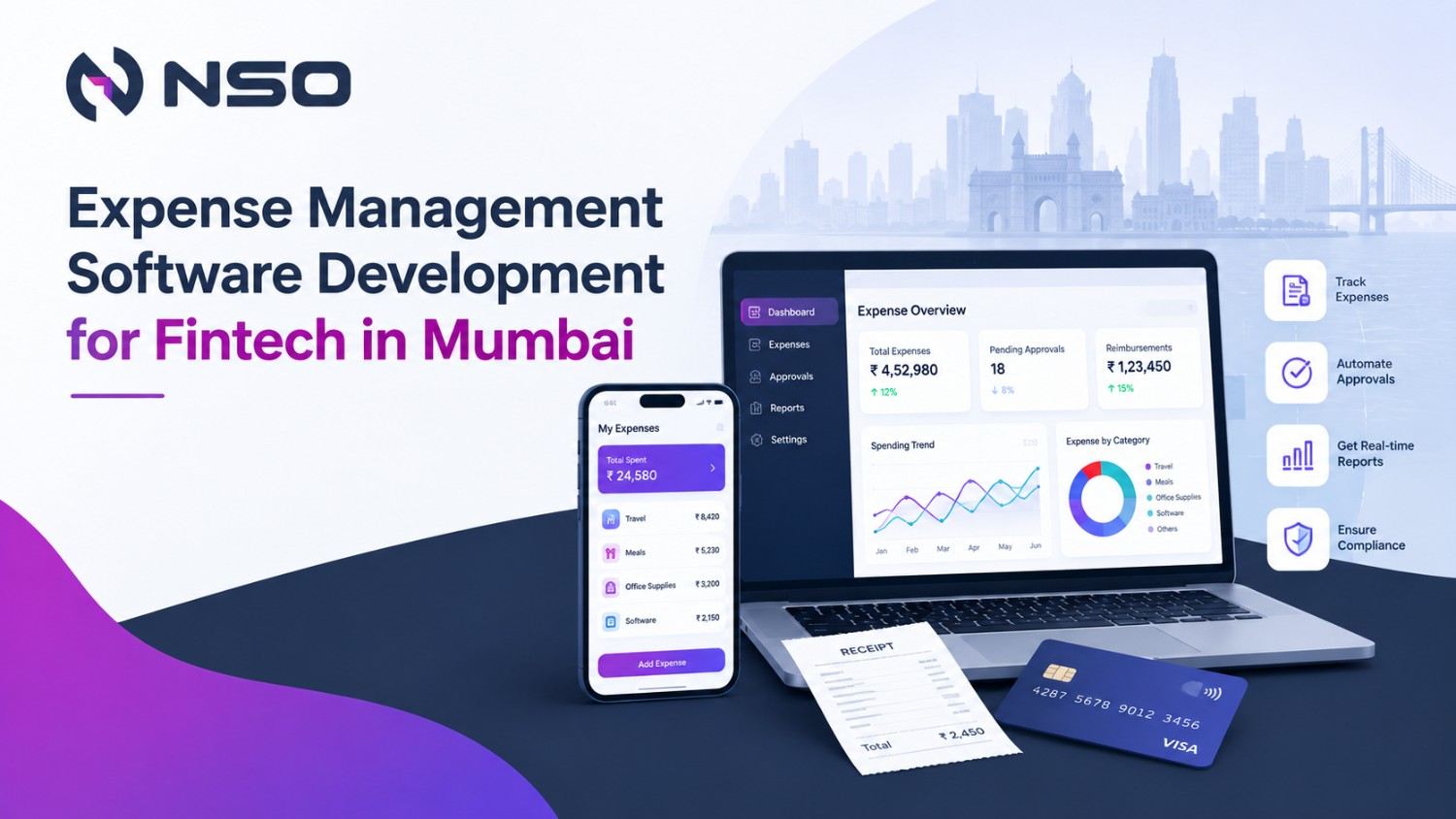
7. Real-Time Dashboards
Finance managers can monitor:
- Total expenses
- Pending approvals
- Reimbursements
- Department spending
- Policy violations
- Monthly expense trends
- Budget utilization
8. Reports and Analytics
Custom reports can help businesses understand spending patterns and identify areas requiring financial control.
Cloud-Based Expense Management Software
A cloud based expense management software solution can provide fintech organizations with centralized access to expense data without depending on locally installed systems.
Cloud architecture can support:
- Remote access
- Centralized data management
- Scalable infrastructure
- API-based integrations
- Automated backups
- Multi-location operations
- Role-based access
- Continuous system updates
For growing fintech businesses, cloud infrastructure can also make it easier to add new users, departments, workflows, and integrations as operational requirements evolve.
Custom Expense Management Development for Fintech
Every fintech business has different operational processes. A startup may need a lightweight employee expense platform, while an established financial organization may require complex approval hierarchies, corporate card integrations, ERP connectivity, analytics, and multi-entity support.
This is where custom expense management development services in Mumbai can provide flexibility.
A custom solution can be designed around:
- Existing business workflows
- User roles and permissions
- Expense policies
- Financial integrations
- Approval structures
- Reporting requirements
- Mobile requirements
- Security architecture
- Scalability requirements
Rather than forcing business processes into a generic product, custom development allows organizations to build workflows around their actual requirements.
How AI Can Improve Expense Management
AI can add another layer of automation to expense platforms.
Potential use cases include:
- Receipt data extraction
- Automatic expense categorization
- Duplicate expense detection
- Anomaly identification
- Policy violation detection
- Spending pattern analysis
- Intelligent approval routing
- Automated financial insights
For example, if similar receipts are submitted multiple times, an intelligent system can flag potential duplicates for finance-team review.
AI should complement financial controls rather than replace human oversight, particularly for sensitive or high-value transactions.
Benefits of Our Custom Expense Management Software
A well-designed platform can help fintech organizations achieve several operational benefits.
Operational efficiency
Automating repetitive processes can reduce administrative workloads.
Better financial visibility
Centralized dashboards can provide finance teams with a clearer view of organizational spending.
Improved policy compliance
Automated rules can identify expenses that require additional review.
Faster approvals
Workflow automation can reduce unnecessary back-and-forth between employees, managers, and finance teams.
Scalable architecture
The platform can evolve as the organization adds employees, departments, entities, and integrations.
Better reporting
Finance teams can generate reports based on departments, categories, projects, locations, and time periods.
How We Develop Expense Management Software
A structured development approach can help fintech businesses build a reliable solution.
1. Requirement Analysis
Identify users, expense types, approval rules, integrations, reporting requirements, and compliance considerations.
2. UX/UI Design
Create intuitive interfaces for employees, managers, finance teams, and administrators.
3. Architecture Planning
Define application architecture, database structure, APIs, security controls, and integration requirements.
4. Development
Build the core expense management modules, dashboards, workflows, APIs, and integrations.
5. Testing
Conduct functional, security, integration, performance, and user-acceptance testing.
6. Deployment
Deploy the platform using an infrastructure appropriate for the organization's security and scalability requirements.
7. Continuous Improvement
Monitor usage, collect feedback, improve workflows, and introduce additional automation as business needs evolve.
Why Choose NSO for an Expense Management Software Development Company?
NSO is a Software development company in Mumbai helping businesses develop customized digital solutions around specific operational requirements.
For fintech organizations, NSO can help with:
- Custom expense management platforms
- Expense tracking applications
- ERP and accounting integrations
- AI-powered receipt processing
- Automated approval workflows
- Financial dashboards
- Web and mobile applications
- API development and integration
- Cloud-based application development
- Enterprise software modernization
As a custom software development company, NSO focuses on understanding the business process before designing the technology solution. This approach can help fintech organizations build an expense platform that supports their current requirements while remaining adaptable for future growth.
Introducing Fineye: Smarter Expense Management for Modern Businesses
Fineye is a smart expense management software designed to help businesses streamline their entire expense management process.
Key capabilities include:
- Expense Tracking: Monitor and manage business expenses from one centralized platform.
- Receipt Management: Capture and organize digital receipts for easier expense processing.
- Automated Approvals: Create structured approval workflows and reduce manual follow-ups.
- Spending Monitoring: Gain better visibility into business spending and expense patterns.
- Real-Time Insights: Access up-to-date financial information through dashboards and reports.
- Expense Analysis: Analyze spending trends to support better financial decision-making.
- Reduced Manual Work: Automate repetitive expense management tasks and improve finance-team efficiency.
- Centralized Management: Bring expense tracking, approvals, reporting, and monitoring together in one platform.
- Built for Modern Businesses: Support the expense management needs of growing businesses and fintech organizations.
Conclusion
Managing business expenses efficiently is increasingly important for fintech organizations that need stronger financial visibility, faster workflows, and scalable operations. Expense Management Software development in Mumbai, can connect expense submission, receipt processing, policy validation, approvals, reimbursement, reporting, and financial integrations within one digital ecosystem.
Nova Strategic Operations helps fintech businesses plan, design, develop, integrate, and scale customized expense management solutions based on their operational requirements. From expense tracking software and cloud applications to ERP integrations, AI-powered document processing, dashboards, and automated workflows, our software development services can support different stages of the expense management lifecycle.
As an experienced software development company, NSO focuses on building practical, secure, and scalable technology solutions rather than one-size-fits-all systems. Looking to build a custom expense management platform for your fintech business? Book a consultation with NSO and discuss your requirements with our development team.
Frequently Asked Questions
1. What is expense management software for fintech companies?
Expense management software for fintech companies is a digital platform that helps manage expense submission, receipt capture, approvals, policy controls, reimbursement, reporting, and financial integrations.
2. Can expense management software integrate with an ERP?
Yes. Expense platforms can be integrated with ERP systems through APIs or other integration mechanisms to synchronize relevant expense, accounting, reimbursement, and reporting data.
3. What features should fintech expense management software include?
Important features can include receipt capture, OCR, expense tracking, approval workflows, policy management, reimbursement, corporate card integration, dashboards, reporting, role-based access, audit trails, and API integrations.
4. Why choose custom expense management software instead of an off-the-shelf product?
Custom development can be useful when a fintech company has specialized workflows, approval structures, integrations, reporting requirements, or security needs that generic software cannot accommodate effectively.
5. How much does expense management software development cost?
The cost depends on factors such as the number of features, platforms, integrations, AI capabilities, user roles, security requirements, customization, and development complexity. A detailed requirement assessment is generally needed to estimate the project accurately.