
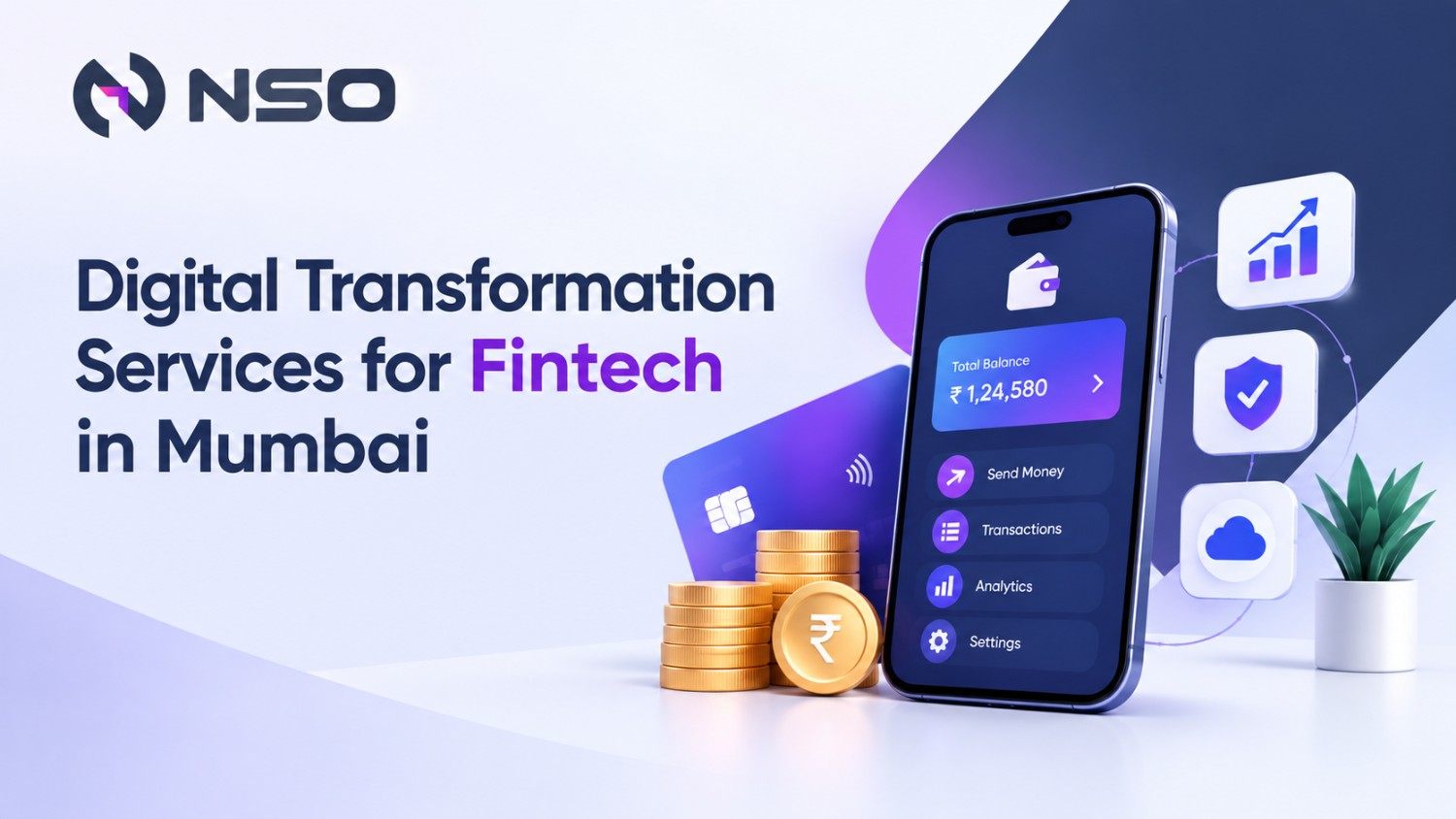

What happens when a fintech company has great products but its technology cannot keep pace? Slow onboarding, disconnected systems, manual operations, limited customer insights, and rising security concerns can quickly become barriers to growth. For fintech businesses, digital transformation is no longer simply about moving processes online, it is about creating connected, intelligent, secure, and scalable financial technology ecosystems.
The fintech landscape in India is increasingly moving toward AI-enabled operations, cloud-native infrastructure, API-led connectivity, real-time data processing, and stronger governance. Industry discussions in 2026 have highlighted AI, cloud, APIs, governed data, and scalable architecture as important foundations for the next generation of fintech platforms.
For fintech companies operating in Mumbai, investing in the right Digital transformation services can help modernize legacy systems, automate financial workflows, improve customer experiences, and create technology foundations that support long-term business growth.
What Is Digital Transformation for Fintech?
Digital transformation for fintech involves using modern technologies and redesigned processes to improve how financial businesses operate, serve customers, manage data, and deliver products.
It goes beyond implementing a new application or migrating data to the cloud. A successful transformation connects technology, people, processes, and business objectives.
For example, a fintech company may transform its loan processing workflow by combining:
- Digital customer onboarding
- eKYC and document verification
- Automated credit assessment
- AI-powered risk analysis
- API integrations
- Digital payment processing
- Real-time dashboards
- Automated customer communication
The result is a connected workflow rather than a collection of disconnected digital tools.
Why Fintech Companies Need Digital Transformation
Financial businesses operate in an environment where speed, security, compliance, and customer experience directly affect business performance. Modernization can help fintech companies address these requirements while preparing their platforms for future technologies.
1. Replace Manual Financial Processes
Manual data entry, document verification, approval workflows, reconciliation, and reporting can consume significant employee time.
Automation can help fintech businesses streamline repetitive processes and allow teams to focus on higher-value activities.
For example:
Traditional process:
Customer submits documents → employee reviews documents → data is entered manually → approval is requested → customer receives an update.
Transformed process:
Customer submits documents → AI extracts information → verification workflow runs → rules are applied → employee reviews exceptions → automated notification is sent.
This type of workflow can reduce unnecessary manual intervention while maintaining appropriate human oversight.
2. Connect Disconnected Systems
Fintech businesses often rely on multiple platforms for payments, accounting, CRM, KYC, lending, customer support, analytics, and compliance.
When these systems operate independently, employees may have to move information manually between platforms.
API-led integration can connect these systems and create smoother information flows. Current fintech technology discussions increasingly emphasize API-first interoperability and resilient architecture as important components of scalable financial technology.
3. Improve Customer Experience
Customers expect financial services to be fast, convenient, and available across digital channels.
Digital transformation in financial services can support experiences such as:
- Faster digital onboarding
- Personalized financial recommendations
- AI-powered customer support
- Instant application status updates
- Digital document submission
- Automated notifications
- Mobile-first financial services
- Self-service portals
For example, an AI-powered customer assistant can answer routine questions about applications, transactions, account services, or documentation while escalating complex requests to human teams.
Key Digital Transformation Services for Fintech
A fintech transformation strategy should be designed around the organization's technology environment and business objectives rather than a fixed list of technologies.
AI and Intelligent Automation
AI can support customer service, document processing, fraud monitoring, risk analysis, financial insights, and workflow automation.
Generative AI and agentic AI are also increasingly being explored for financial operations, including customer assistance, compliance, lending, and fraud-related workflows.
Cloud Modernization
Cloud transformation can help fintech businesses build infrastructure that is easier to scale and manage.
Cloud-based platforms can support:
- Scalable application infrastructure
- Data storage and processing
- Disaster recovery
- Analytics
- AI workloads
- Remote accessibility
- Infrastructure optimization
API and System Integration
API integration enables fintech platforms to communicate with banks, payment gateways, accounting systems, CRMs, identity providers, third-party financial services, and other applications.
A well-designed integration strategy can reduce data silos and improve operational efficiency.
Data Analytics and Business Intelligence
Financial organizations generate large amounts of customer, transaction, operational, and financial data.
Modern analytics platforms can transform this data into actionable insights through:
- Financial dashboards
- Customer analytics
- Transaction monitoring
- Performance reporting
- Risk analytics
- Predictive models
- Real-time business intelligence
Cybersecurity and Compliance
Digital transformation must be accompanied by strong security architecture.
Fintech organizations can integrate:
- Identity and access management
- Multi-factor authentication
- Encryption
- Secure APIs
- Audit trails
- Fraud monitoring
- Role-based access
- Security monitoring
Security becomes especially important as fintech businesses expand their use of cloud platforms, APIs, AI, and interconnected applications.
Examples of Fintech Digital Transformation
Consider a Mumbai-based lending company that manages applications through spreadsheets, email, and multiple disconnected systems.
A transformation program could introduce a centralized lending platform with:
Customer Application → Digital KYC → Document AI → Credit Assessment → Risk Analysis → Approval Workflow → Digital Disbursement → Customer Notifications
Similarly, an expense-management fintech could connect receipt capture, approval workflows, accounting systems, analytics, and financial reporting into one platform.
These examples demonstrate that transformation is not necessarily about replacing everything at once. Businesses can modernize individual processes and gradually create a connected technology ecosystem.
Digital Transformation Services and Solutions: What Should Fintechs Prioritize?
The right priorities depend on the organization's existing technology and business goals.
A practical transformation roadmap can include:
- Technology assessment – Identify legacy systems, bottlenecks, security gaps, and integration challenges.
- Process mapping – Identify repetitive and manual financial workflows.
- Data strategy – Establish how customer and financial data should be collected, managed, integrated, and analyzed.
- Integration planning – Connect APIs, banking systems, payment platforms, CRM, ERP, and third-party services.
- AI and automation opportunities – Identify workflows where intelligent automation can deliver measurable value.
- Cloud modernization – Move suitable workloads toward scalable and resilient infrastructure.
- Security architecture – Build security, access controls, monitoring, and auditability into the solution.
- Continuous optimization – Monitor performance and improve the platform as business requirements evolve.
This approach allows fintech companies to connect transformation investments with measurable business objectives instead of adopting technology simply because it is trending.
How NSO Helps Fintech Businesses With Digital Transformation
Nova Strategic Operations (NSO) helps fintech companies modernize their technology infrastructure through custom software development, AI, automation, cloud solutions, API integrations, analytics, and digital transformation strategies.
NSO can help businesses transform areas such as:
- Fintech application modernization
- AI-powered financial workflows
- Customer-facing fintech platforms
- Digital onboarding
- KYC and document processing
- CRM and ERP integrations
- Payment and API integrations
- Intelligent automation
- Data analytics and BI dashboards
- Cloud-based financial applications
- Custom expense management platforms
- AI-powered customer support
NSO's existing fintech software development approach also covers areas such as KYC, AML, compliance workflows, risk monitoring, regulatory reporting, audit trails, integrations, security, scalability, and automation.
Frequently Asked Questions
1. What are digital transformation services for fintech companies?
Digital transformation services help fintech companies modernize applications, automate financial workflows, integrate systems, adopt cloud technologies, use AI and analytics, and strengthen their digital infrastructure.
2. How does digital transformation improve financial services?
Digital transformation in financial services can improve operational efficiency, customer experience, data accessibility, automation, system integration, scalability, and decision-making.
3. Can digital transformation integrate with existing fintech systems?
Yes. API integration and modernization strategies can connect existing banking platforms, payment gateways, CRMs, ERPs, accounting systems, databases, and third-party financial services without necessarily replacing every existing system.
4. What technologies are used in fintech digital transformation?
Common technologies include AI, machine learning, cloud computing, APIs, data analytics, automation, intelligent document processing, cybersecurity technologies, mobile applications, and modern software architectures.
5. How should a fintech company start its digital transformation journey?
A fintech company should begin by assessing its current technology environment, identifying operational bottlenecks, defining measurable business objectives, prioritizing transformation opportunities, and developing a phased technology roadmap.
Conclusion
Digital transformation is essential for building scalable, customer-focused, and resilient fintech businesses. From AI-powered automation and cloud modernization to API integration, analytics, cybersecurity, and custom software development, Digital transformation services and solutions help fintech companies streamline operations and improve customer experiences.
The goal is not to adopt every emerging technology but to implement solutions that address genuine business challenges and deliver measurable value. Nova Strategic Operations helps fintech businesses in Mumbai transform their operations through custom software development, AI, automation, system integrations, cloud applications, and data-driven platforms. Whether you are modernizing an existing fintech product or developing a new financial technology platform, NSO provides the expertise to plan and execute your transformation journey.
Ready to modernize your fintech business? Contact us today to discuss your requirements and build a scalable digital transformation roadmap.