

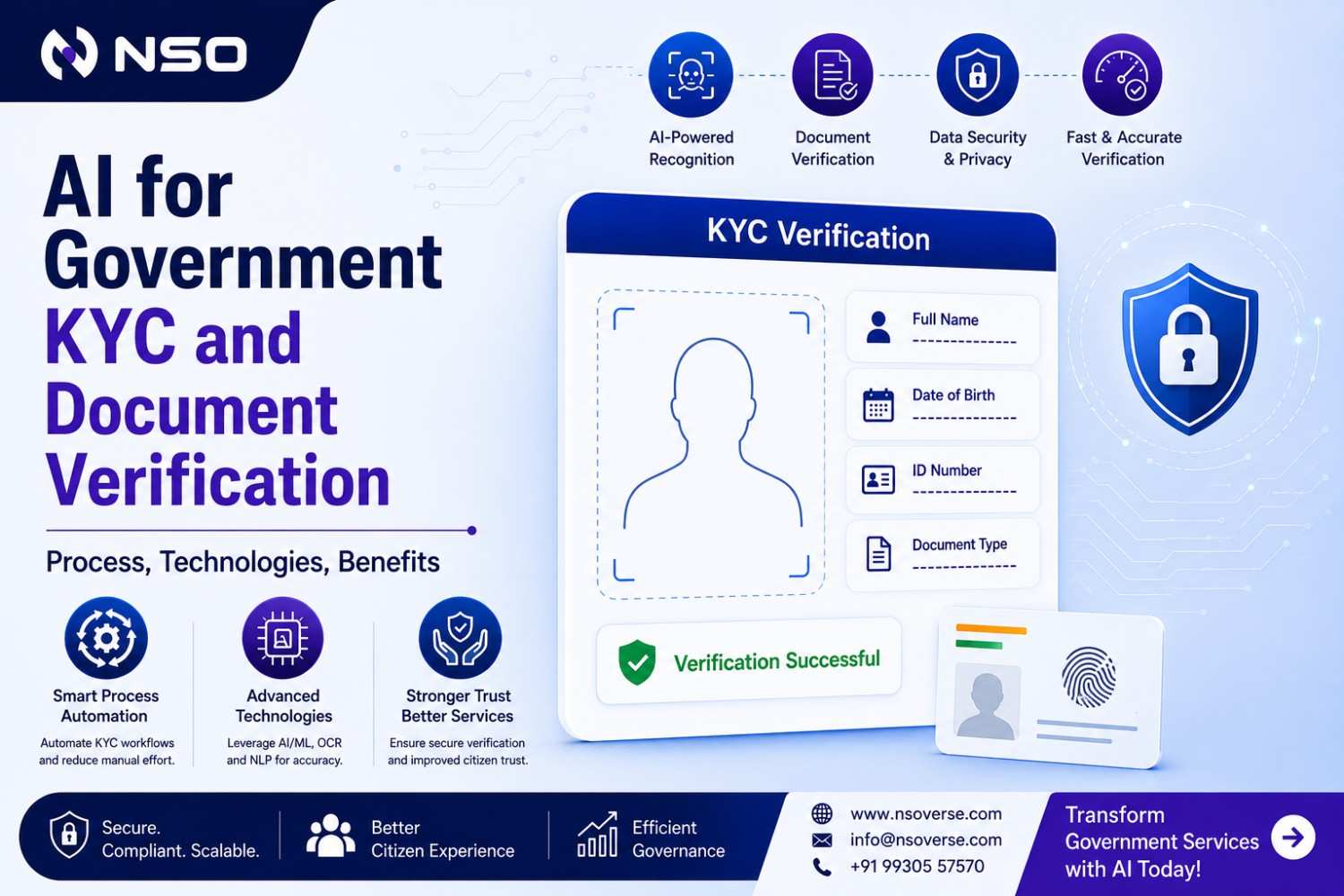

Every minute a government officer spends manually verifying identity documents is another minute citizens spend waiting for essential public services. As digital governance expands, traditional verification methods can no longer keep pace with growing application volumes, rising identity fraud, and increasing citizen expectations for instant service.
Traditional document verification methods often involve manual checks, physical paperwork, and long approval cycles. These processes increase operational costs, delay service delivery, and leave room for human error and document fraud.
Artificial Intelligence (AI) is transforming how government departments perform Know Your Customer (KYC) and document verification. Instead of manually reviewing each application, AI-powered systems can verify identity documents, detect forged records, validate information across government databases, and complete verification within seconds.
What Is AI-Powered Government KYC and Document Verification?
AI-powered government KYC is the use of artificial intelligence to automatically verify an individual's identity using government-issued documents and biometric authentication.
The objective is to ensure that:
- Citizens are genuine.
- Submitted documents are authentic.
- Personal information matches official records.
- Duplicate or fraudulent identities are detected before service approval.
Unlike conventional verification, AI continuously learns from verification patterns and improves its fraud detection capabilities over time.
Why Governments Need AI for Identity Verification
Government agencies face several challenges during citizen verification:
- Fake identity documents
- Identity theft
- Duplicate applications
- Long verification timelines
- Manual processing errors
- High administrative costs
- Increasing online service requests
- Compliance with digital identity regulations
As governments move toward digital governance, these challenges become more significant. AI provides scalable automation while maintaining security and compliance.
Step-by-Step AI Government KYC Process
AI-powered government KYC follows a structured verification workflow that securely validates citizen identities, detects fraud, and accelerates document approval using intelligent automation.
1. Digital Document Submission
Citizens upload identity documents through a government portal, mobile application, or self-service kiosk.
Common documents include:
- National ID
- Passport
- Driver's License
- Birth Certificate
- Tax Identification Number
- Voter ID
- Residence Certificate
The AI system accepts scanned copies, PDFs, or smartphone images.
2. Image Quality Assessment
Before processing, AI evaluates document quality by checking:
- Blur detection
- Low resolution
- Cropped edges
- Lighting conditions
- Missing document sections
- Image tampering
If the image quality is poor, the citizen is prompted to upload a better copy.
3. OCR-Based Data Extraction
Optical Character Recognition (OCR) automatically extracts important information, including:
- Full name
- Date of birth
- Address
- Identification number
- Issue date
- Expiry date
- Gender
- Document issuer
Advanced AI OCR can read:
- Printed text
- Handwritten fields
- Multiple languages
- Regional scripts
- Damaged documents
4. Document Authenticity Verification
AI validates whether the submitted document is genuine by examining:
- Security patterns
- Fonts
- Watermarks
- QR codes
- Digital signatures
- Holograms
- Machine-readable zones (MRZ)
- Barcode consistency
Computer vision models compare uploaded documents against official document templates to identify alterations or counterfeit versions.
5. Facial Verification
If biometric verification is required, AI compares the citizen's selfie with the photograph on the submitted ID.
Modern facial recognition checks:
- Facial landmarks
- Eye position
- Nose structure
- Skin texture
- Face geometry
- Head movement
- Expression consistency
This significantly reduces impersonation attempts.
6. Liveness Detection
Fraudsters often attempt verification using:
- Printed photographs
- Mobile screen images
- Recorded videos
- Deepfake videos
AI-based liveness detection confirms that a real person is present by analyzing:
- Natural eye blinking
- Facial movements
- Depth estimation
- Reflection patterns
- Micro facial expressions
7. Cross-Database Validation
The extracted information is compared against authorized government databases.
AI validates:
- Identity records
- Tax databases
- Population registry
- Social welfare records
- Immigration databases
- Vehicle registration
- Criminal records (where legally permitted)
This ensures submitted information is accurate and current.
8. Risk Scoring
Machine learning assigns a fraud risk score using factors such as:
- Identity mismatch
- Suspicious document patterns
- Previous verification attempts
- Duplicate identities
- Device fingerprint
- Location anomalies
- Behavioral analysis
Low-risk applications proceed automatically, while high-risk cases are flagged for manual review.
9. Automated Approval or Escalation
Based on confidence scores, AI can:
- Approve verification automatically
- Request additional documents
- Trigger manual verification
- Reject fraudulent applications
This hybrid approach balances automation with human oversight.
Technologies Used in AI Government KYC
AI-powered government KYC combines advanced technologies to automate identity verification, improve accuracy, strengthen security, and detect fraud efficiently.
Artificial Intelligence
AI models continuously improve document classification, fraud detection, and verification accuracy using historical verification data.
Machine Learning
Machine learning identifies unusual verification patterns, predicts fraud risks, and improves decision-making over time.
Computer Vision
Computer vision analyzes visual features such as document layout, security marks, signatures, and facial characteristics.
Optical Character Recognition (OCR)
OCR converts document images into structured digital information, reducing manual data entry.
Natural Language Processing (NLP)
NLP helps understand multilingual forms, handwritten notes, and citizen-submitted text fields.
Facial Recognition
Facial recognition matches live facial images with government-issued identity documents.
Biometric Authentication
Additional biometric methods may include:
- Fingerprint verification
- Iris recognition
- Voice authentication
- Palm vein recognition
Blockchain (Optional)
Some governments integrate blockchain to create tamper-resistant digital identity records and maintain secure audit trails.
Key Benefits of AI for Government KYC
AI-powered KYC enables governments to verify identities faster, reduce fraud, improve compliance, and deliver secure, efficient citizen services.
Faster Citizen Verification
Identity verification that once required several days can now be completed within minutes or even seconds.
Reduced Identity Fraud
AI detects forged documents, altered identities, and impersonation attempts with greater accuracy than manual verification.
Improved Public Service Delivery
Citizens receive faster approvals for government services, reducing queues and administrative delays.
Lower Operational Costs
Automated verification significantly decreases manual workload and paperwork.
Better Compliance
AI systems automatically follow predefined verification rules and generate complete audit logs for regulatory compliance.
Higher Accuracy
Automated validation minimizes human errors during document review.
Scalability
Government agencies can process millions of verification requests without proportionally increasing staffing levels.
Enhanced Citizen Experience
Online verification eliminates the need for repeated office visits, reducing inconvenience for citizens.
Real-World Government Use Cases
AI-powered KYC and document verification enable governments to deliver faster, secure, and fraud-resistant digital public services.
Digital Citizen Registration
Governments use AI to verify identity documents during digital citizen onboarding for online public services.
Passport Application Verification
AI validates supporting documents before passport officers conduct final approval.
Driver's License Issuance
Identity verification helps prevent duplicate licenses and fraudulent applications.
Social Welfare Programs
AI ensures that benefits reach eligible individuals while reducing duplicate or fake beneficiary records.
Taxpayer Registration
Automated KYC verifies taxpayer identities during business and individual tax registrations.
Immigration and Border Control
AI speeds up passport verification, facial recognition, and traveler identity validation at airports and border checkpoints.
Government Employee Verification
Public sector recruitment processes use AI to validate educational certificates, identity documents, and employment records.
Public Healthcare Enrollment
Healthcare systems verify citizen identities before issuing health cards or approving government medical schemes.
Digital Business Registration
AI verifies company directors, beneficial owners, and legal documents during online business registration.
Conclusion
AI-powered KYC and document verification are transforming how governments deliver secure, efficient, and citizen-centric services. By combining OCR, computer vision, facial recognition, machine learning, and biometric authentication, public agencies can automate identity verification, reduce fraud, improve compliance, and accelerate service delivery.
When implemented with strong privacy safeguards, transparent governance, and human oversight, AI enables governments to build trusted digital ecosystems that support faster access to public services without compromising security.
At Nova Strategic Operations (NSO), we help government organizations build secure AI-powered digital transformation solutions, including intelligent document processing, AI-driven citizen verification, workflow automation, and enterprise-grade AI platforms.
Our solutions are designed to improve operational efficiency, strengthen compliance, and deliver seamless digital experiences for citizens. Contact us to explore how AI can modernize your government verification processes.
Frequently Asked Questions
1. What is AI-based KYC in government services?
AI-based KYC is an automated identity verification process that uses technologies such as OCR, facial recognition, machine learning, and computer vision to verify citizens and validate government-issued documents digitally.
2. Which government documents can AI verify?
AI can verify passports, national identity cards, driver's licenses, voter IDs, birth certificates, residence certificates, tax identification documents, business registration certificates, and many other official records.
3. How does AI detect fake government documents?
AI analyzes document templates, security features, watermarks, QR codes, fonts, holograms, metadata, and visual inconsistencies to identify forged or altered documents.
4. What is OCR in AI document verification?
OCR (Optical Character Recognition) extracts text and data from scanned or photographed documents, converting them into structured digital information for automated verification.
5. How does facial recognition improve government KYC?
Facial recognition compares a live selfie with the photograph on an identity document to confirm that the applicant is the legitimate document holder.
6. What is liveness detection, and why is it important?
Liveness detection verifies that a real person—not a printed photo, recorded video, or deepfake—is present during identity verification, helping prevent impersonation fraud.
7. Can AI verify multilingual government documents?
Yes. Advanced AI models can process documents in multiple languages and regional scripts, making them suitable for multilingual government services.

.png)




.png)

.png)
.png)
.png)
_(1).png)
.png)